

Mortgage Rates Outlook: Fed Surprises, Strong Data, and Rising Oil Push Rates Higher

Mortgage rates pushed higher this week, shaping the broader mortgage rates outlook as markets reacted to a mix of economic strength, rising energy prices, and an unexpected shift in Federal Reserve dynamics.
While the Fed left rates unchanged, the real story was beneath the surface. Increased dissent among policymakers and unusual commentary from Chair Jerome Powell introduced a new layer of uncertainty, one that markets are still working through. Combined with resilient economic data and renewed pressure from oil prices, the result was a clear move higher in long-term rates.
What Drove Rates Higher This Week
Interest rates pushed higher this week, reaching their highest levels in nearly a month, as markets worked through a steady stream of data and one very unexpected development about the Fed.
Inside the Fed: Dissent and Uncertainty
The Federal Reserve left rates unchanged, as expected...but the story was in the details. There were four dissenters: one calling for a rate cut and three pushing against the signal that the next move will be lower. That’s the most dissent we’ve seen in over 30 years.
The real surprise came during Powell’s press conference. He announced he intends to remain on the Board for a period while an ongoing investigation is resolved, reminding the world: “I have no intention of leaving the board until the investigation is well and truly over with transparency and finality.”
Powell emphasized he is not trying to act as a “shadow Fed” and acknowledged this will be Warsh’s Fed to run. Still, this is highly unusual. The last time a Fed Chair stayed on as a Governor was nearly 80 years ago, and that moment came at a Presidential request.
By Thursday, the bond market had its third and more measured or real reaction, with prices edging higher and offering modest rate relief.
A Resilient Economy Keeps Pressure on Rates
Powell reiterated the economy remains strong and the data backed it up. Durable Goods and Housing Starts beat expectations, while Initial Claims came in historically low. GDP was reported at 2.0%.
Bottom line: the economy is still growing, the consumer is still spending, and recession risks remain low.
Oil Prices and Inflation Concerns Return
Energy prices surged on uncertainty surrounding Iran, pushing oil above $100. As we often see, higher oil prices helped drive long-term rates, including mortgages, higher.
Why 4.35% Matters for the 10-Year Treasury
The 10-Year Treasury is testing a key ceiling at 4.35%. A sustained move above this level likely opens the door to a retest of the 2026 highs near 4.48%.
30-Year Mortgage Rates and 10-Year Note
30-Year Fixed Mortgage Rate (Freddie Mac daily average, April 30, 2026)
Rate: ~6.30% (current average 30-year fixed rate)
Change from previous week: up from ~6.23% (week ended April 23, 2026)
Change year-over-year: down from ~6.76% on May 1, 2025 (Freddie Mac)
10-Year Treasury Note Yield (Daily close, April 30, 2026)
Yield: ~4.30%
Change from previous week: down from ~4.32% (week ended April 23, 2026)
Change year-over-year: up from ~4.17% on April 23, 2025
What to Watch in the Week Ahead
In the week ahead, markets will be focused on a full slate of economic data that could shape the next move in rates. Labor market reports, including ADP and the Jobs Report, will provide key insight into employment trends, while housing data will continue to reflect the impact of higher rates on demand.
ISM Services and Productivity will help gauge overall economic momentum and inflation pressures, while JOLTS and Consumer Sentiment will offer a closer look at the strength of the consumer.
Mortgage Market Guide Candlestick Chart
Each candle represents one day of trading. As mortgage bonds prices move higher, rates move lower. You can see on the right side of the chart, how mortgage bond prices are trying to rebound higher in price this past week.
Chart: Fannie Mae 30-Year 5.5% Coupon (Friday, May 1, 2026)

Economic Calendar for the Week of May 4 - May 8, 2026
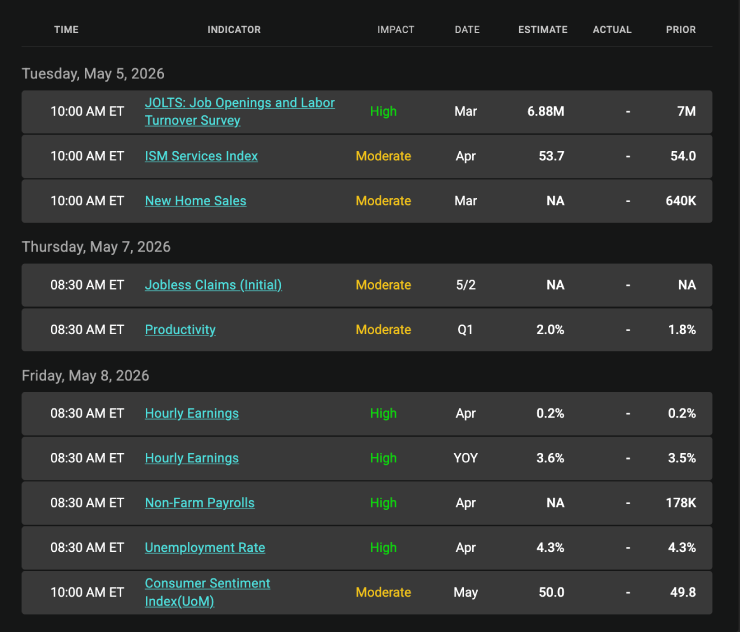
As markets head into a data-heavy week, the focus shifts to labor market reports, housing activity, and broader measures of consumer strength. These inputs will play a critical role in determining whether rates stabilize or continue to push higher.
With the 10-year Treasury testing key technical levels and multiple macro factors in play, this remains a market driven by both data and sentiment. For borrowers and investors alike, staying informed and proactive will be key as the next phase of rate movement begins to unfold.


Comments